
Can Art-of-the-Deal Chaos Promote Resilience in a Fragile System?

I’ve been stewing on an idea lately, circling around it from different angles, and it keeps coming back stronger every time I think about it. It’s about the Trump administration’s governing style—and how it resembles something most wouldn’t expect: chaos engineering.
Let me explain.
Beyond "Art of the Deal" Logic
A lot of people chalk up Trump’s style to the famous Art of the Deal mentality: bold moves, brinkmanship, transactional negotiations. And sure, that’s the gist of it. But I think it’s more than a philosophy of dealmaking—it’s a governing approach that many swear by as an effective leadership approach. My skeptical nature begs the question: could it really have any merit?
Until recently I did not know exactly what was included in Art of the Deal. A few googles and AI chats later...
The essence of Trump's book, The Art of the Deal, offered a multi-step negotiating strategy centered on creating leverage, stirring uncertainty, and framing negotiations in a way that made the other side question their footing. It relied on bold opening moves, selective bluffing, setting high initial demands, and then navigating the chaos these tactics generated toward a more favorable position.
In this sense, The Art of the Deal wasn't merely a philosophy of winning deals—it was a playbook for destabilizing the status quo to create openings or opportunities. That same mentality, scaled up to governing a nation, looks a lot like a form of deliberate disruption: injecting volatility into systems to test their resilience, shake out weaknesses, and force adaptation.

Now let's take a look at chaos engineering...
In technology, chaos engineering is the practice of intentionally introducing failures or disruptions to test how a system responds under stress. Rather than waiting for failure to happen on its own, you simulate it, watch what breaks, and use the insights to make the system stronger and more adaptable.
In software, chaos engineering can be carefully measured, staged, and isolated to specific components in a controlled environment. But as the U.S. executive branch, you can't isolate variables in the same way; policy decisions happen in full public view, interconnected with markets, politics, international relations, and media cycles. Every disruption triggers a cascade of unintended consequences, feedback loops, and political reactions.
There’s no safe sandbox—everything is live. So while you can't run a formulaic, controlled chaos experiment in government, you can observe failures and disruptions in real time, make decisions based on immediate feedback, and use bold moves as probes to reveal hidden fragilities in institutions and alliances.
So the connection was made... What if The Art of the Deal wasn’t such a unique idea. What if it was rather a blueprint for applying chaos engineering concepts to domains beyond technology systems, like deal-making, governance, capitalist economy, political structures, or even global alliance networks?
Tech Industry Parallels
One reason so many commentators struggle to make sense of Trump’s administration is because it doesn't fit the usual mold. People keep looking for a grand strategy or a coherent ideology (and in some cases they are pleading for it), but instead they see what looks like a chaotic swirl of ideas, factions, and contradictory policies.
But what if we flip the lens? What if the unifying element wasn’t the specific policy positions, but the approach to governance itself?
I work for a software company where things change fast. Like many of these enterprises, you often run with an idea before it's fully baked and you learn on the fly. You have a general idea of the direction, but the details need to be worked out as you go.
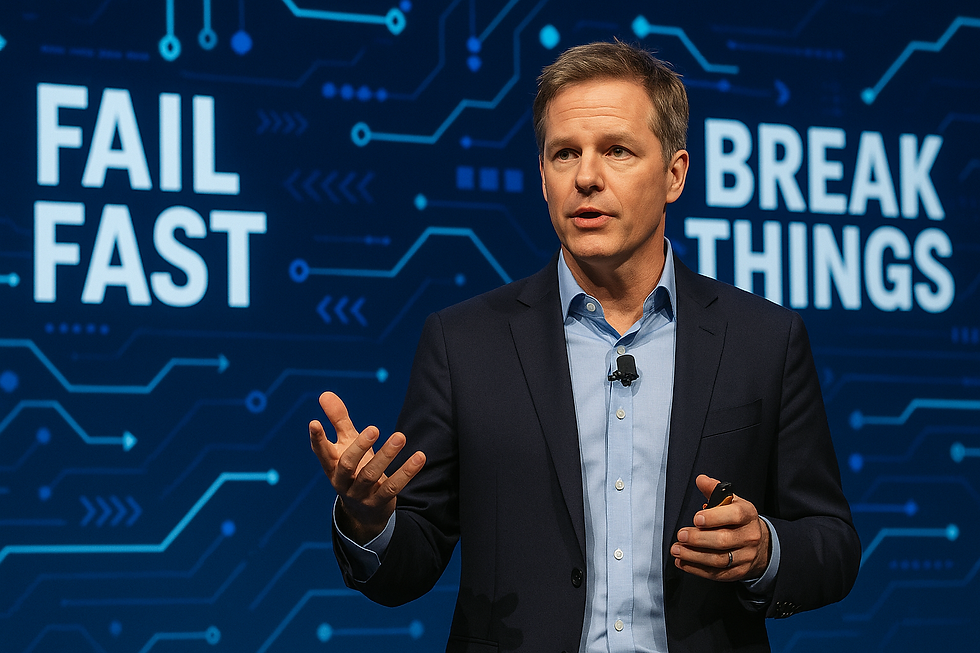
The whole technology industry seems to operate like this. We have slogans like, "fail fast," or "move fast and break things." I hear teams saying things like, "we'll pound out that dent at some point," or "we're building as we fly," and those ideas are generally accepted because, well, things change fast and ideas take real-world testing to know if they will work.
This ties into chaos engineering as a discipline, which isn’t about one perfect test. It’s about running lots of different experiments, each targeting a different part of the system to see where failure might happen.
A Unifying Mission & Disjointed Methods
Another point that I see commentators miss on is the "King Trump" idea. If you look closely it's obvious that the administration functions not as a king and his faithful servants, but as a coalition of ideas. He has assembled a lot of independent thinkers and successful business people who have strong personalities and convictions.
Together they form a consortium with a plethora of ideas. It seems that Trump has some of his own ideas, and he likes to borrow and consider the ideas of others. They don't all have to agree, and their ideas may indeed make it into practice. But they all need to be willing to try different approaches, see what sticks, and pivot on the fly.
Take trade policy as an example. There are various visions around trade policy and tariffs within the cabinet. There are disagreements as to what extent to employ tariffs and how much reindustrialization is needed by the US. Some want to emulate China's massive industrialization while others are focused more on thigh-tech manufacturing, and some want to avoid trade war while others are willing to go after it full tilt.
In practice, they remain flexible. The pressure on various nations to loosen non-tariff barriers, the public threats against Canada and Mexico, the sudden imposition of embargo-like tariffs on China—each one was a jolt to the system. And while they were often presented as ultimatums, they weren’t always followed through exactly as announced. They were bold disruptions, seemingly meant to test the system’s response, observe real-time feedback, and recalibrate.
These disruptions led to immediate negotiations and discussions with firm deadlines. For weeks we saw nations sending representatives to Washington on a daily basis, apparently to avoid being the target of disruptive tactics.
In many cases, the pivots were fast (or even nauseating). The administration would float a policy, trigger a reaction from markets, allies, or domestic opposition, and then shift course—sometimes within days. It wasn’t a slow, bureaucratic process of weighing every possible outcome. It was a more experimental, high-variance approach: mess around and find out.
And notably, they were willing to endure backlash in order to get that information. Usually, a president would take more care for their approval and act cautiously. In this case, I think we would all agree their approach has been very controversial and at least somewhat unpopular.
Blitzkrieg as a Governance Tool
One known factor in all of this is that the administration's objectives seem quite clear: reindustrialize America, reduce reliance on foreign supply chains, address the debt problem (or at least sell more bonds), challenge globalist trade orthodoxy, and pull back from costly foreign entanglements. And they don't seem to be patient. They aren't about to attempt getting there with methodical, ten-year plans.
Instead, it's more like a blitzkrieg—a rapid, overwhelming push on multiple fronts that prevent opposition from organizing effectively against any one initiative. By moving quickly and keeping adversaries off-balance, they are forcing the system to react before it can stabilize.

In a political context, this means that critics, lobbyists, and even foreign governments often can't mount coordinated resistance before the next shock arrives. And every time the system wobbles but doesn't collapse, it reinforces the administration’s sense that they can push further.
A Resilience-Building Strategy?
One valid criticism of their approach is that they aren't winning many new friends. If anything, they are putting alliances at risk and seem at-odds with what would otherwise be considered typical diplomacy.
But the question on the diplomacy front remains: What if the chaos isn't random, but a way of forcing systems to expose their weaknesses and adapt? Could such an approach apply to forming better alliances as well?

Consider the supply chain shocks. COVID and the Ever Given event were the first to expose vulnerabilities in global supply chains that amount to a national security issue for the US and many other nations. Trump's new trade wars and tariffs exposed just how dependent the U.S. market has become on Chinese manufacturing. For years, think tanks have published reports warning about this vulnerability, but little changed. It took the blunt force of policy disruption to make companies and policymakers to focus attention on the issue.
Similarly, challenges to NATO spending, though controversial, forced allies to reconsider their defense budgets and pledge to step up. The administration wasn’t necessarily trying to dismantle NATO (despite the rhetoric); it was testing how far the alliance’s commitments could be stretched before recalibrating.
In a world where traditional policy levers were constrained or failing—decades of debt accumulation, institutional sclerosis, demographic decline, stagnating growth—perhaps bold shocks were one of the few remaining tools that could force adaptation quickly enough to matter.
This resonates with something Ray Dalio, the hedge-fund manager turned historian, talks about in his warmings to the West about debt-driven collapse. He stresses the need for "beautiful deleveraging," a process of reducing systemic risks without triggering a collapse.
It seems that in the geopolitical and institutional realm, the US has been over-leveraged in entanglements, failing institutions, and over-valued agreements. The unconventional solution employed is disruptive in the short run, but leads to cutting away unsustainable dependencies and overextensions through confrontation rather than consensus.
Of course, it must also lead to identifying and strengthening sustainable alliances as well. Perhaps this has already been accomplished (UK? India?), but only time will tell.
The Basis Trade Unwind: A Microcosm
One vivid example of all these points happened just a month ago, shortly after Liberation Day (major tariff start date), when the bond market experienced extreme volatility that rippled across global markets. Many speculated that nations were selling U.S. Treasuries, but deeper analysis identified that it was largely due to an unwinding of the basis trade. Hedge funds had piled into leveraged Treasury arbitrage positions, and as volatility spiked, margin calls and liquidity pressures forced rapid liquidations in what was otherwise a very safe asset.
The result was a sudden liquidity tightening that impacted markets far and wide, echoing the mechanics of the 2020 basis trade crisis. The Trump administration showed, at first, willingness to let the system face stress and observe how it would respond. They then stepped in quickly when a serious issue seemed eminent, capturing the broader pattern of testing resilience through disruption.
Their willingness to reverse course is seen as a weakness by critics, and the sudden impact on markets was seen as horrific damage to markets. From the sidelines it was a moment that encapsulated the broader pattern: willingness to let the system face stress to test how it responds, but also readiness to step in to avoid major damage.
It's not as reckless of a strategy as it may seem, given this attention to risk and willingness to change course. In fact, it may even be promoting resilience in the system.
Mess Around and Find Out
Try something bold and disruptive. See how the system reacts. Adjust on a dime if needed. And if it works, double down. That's the good old, "F*** around and find out" model, with a bit more control on the back end.
This isn’t the clean, surgical chaos engineering of a Silicon Valley whiteboard. It’s more like chaos engineering applied with a sledgehammer and a stopwatch—fast, improvised, sometimes sloppy, but aiming for resilience by exposing and forcing adaptation of weak points.
And in the context of a global paradigm shift—a world facing rising debt, deglobalization, demographic headwinds, and institutional decay—maybe this kind of brute-force experimentation is a good way to shake the system into action and win on stronger terms.
Closing Thoughts
I don’t write this to endorse every action or outcome of the administration. But I do think it’s worth exploring this lens: that what looked like chaos may have been, at least in part, a strategy of resilience-building through disruption.
Whether or not you can stomach the chaos comes down to whether you trust the likes of Trump, Bessent, and the rest of their coalition. I tend to really like Scott Bessent as a calming market presence with outstanding experience in these matters and a track record of predicting when things are about to go off the rails.
In an age where institutions struggle to reform themselves from within, maybe it takes external shocks to force renewal. Trust in these institutions has never been lower around the world, so reforms are obviously needed.
Maybe what we witnessed wasn’t chaos for chaos’s sake, but chaos as a crucible. And like all crucibles, it leaves us with hard questions: Did it make us stronger or just reveal how fragile we really are?


Comments